EpoweredMotion is a review site, not a store. Our links take you to Amazon to complete your purchase. As an Amazon Associate, we earn from qualifying purchases.We're a review site, not a store. As an Amazon Associate, we earn from qualifying purchases.As an Amazon Associate, we earn from qualifying purchases.


How Many Miles Can an Electric Scooter Go?
Read Time: 8 min · Updated November 2026
Range is the first number most shoppers look at, and also the one most likely to disappoint. A scooter advertised at 40 miles may deliver 25 on your commute, while another with a bigger battery quietly keeps going. The difference comes down to battery size, weight, speed and how the manufacturer tested it.
Page Navigation
ToggleBelow you will find the Amazon scooters with the longest claimed range, the battery size behind each claim, and the factors that decide how far you will really get. For more models, see our long-range electric scooters guide.
Which Scooters Go the Farthest on One Charge?
These nine pair the longest range claims we found on Amazon with two well-known Segway models for riders who want something lighter, listed from the farthest down. Battery size sits next to each claim because it is the best clue to whether the number is believable. Where a brand does not list a figure, we say so.
| Scooter | Claimed range | Battery | Weight | Top speed |
|---|---|---|---|---|
| ANDBEE JL86 | Up to 75 miles | 60V 40Ah (about 2,400 Wh) | Not listed | Up to 55 mph |
| Tumotcy K8 | Up to 70 miles | 60V 33Ah (about 1,980 Wh) | About 104 lbs | 50 mph |
| ZSNAKE Dual Motor Scooter | 60+ miles | 60V 30Ah (1,800 Wh) | Not listed | 50 mph |
| ZonDoo ZO03 Plus | 60 miles | Not listed | 95 lbs | 55 mph |
| FOHOLO F15 | 55 miles | 60V 21Ah (about 1,260 Wh) | 76.5 lbs | 47 mph |
| HLOIE H1 GEN2 | 55 miles | Not listed | 101 lbs | Up to 50 mph |
| Kugookirin G2 Max | 50 miles | 48V 20Ah (about 960 Wh) | About 68 lbs | 35 mph |
| Segway ZT3 Pro | 43.5 miles | Not listed | 65.5 lbs | 24.9 mph |
| Segway Ninebot MAX G2 | 43 miles | Not listed | 53.5 lbs | 22 mph |

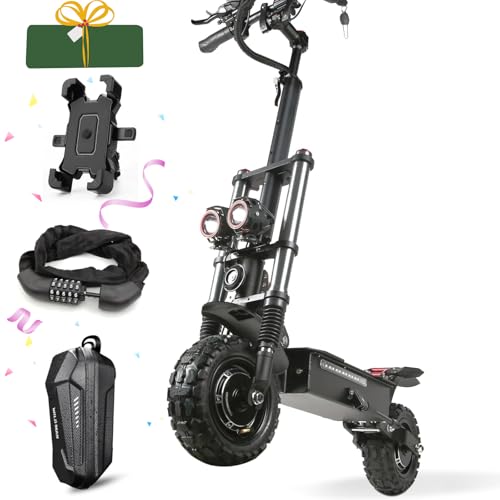


Prices as of Nov 23, 2026 6:51 AM GMT+0000 and subject to change. The price and availability shown on Amazon at the time of purchase will apply.
Notice the trade-off: the longest-range scooters are fast, powerful and heavy, and several weigh 70 to 100 pounds. If you need to carry yours, or you only ride a few miles, a lighter model with a smaller battery is the smarter buy.
How Electric Scooter Range Is Measured
Claimed vs. Real-World Range
Manufacturers usually test under ideal conditions: a rider around 165 pounds, flat ground, a steady moderate speed and mild weather. Add hills, a heavier rider, stop-and-go traffic or a cold morning and the number drops. Plan on getting noticeably less than the label, especially on the first few rides while the battery settles in.
A Quick Way to Sanity-Check a Claim
Divide the battery capacity in watt-hours (Wh) by the claimed miles. Watt-hours are volts times amp-hours, so a 48V 20Ah battery holds about 960 Wh. In normal riding most scooters use somewhere around 15 to 30 Wh per mile, depending on speed and weight.
The Kugookirin G2 Max works out to about 19 Wh per claimed mile, which is believable for gentle riding. The FOHOLO F15 comes to about 23, the Tumotcy K8 to about 28 and the ANDBEE JL86, at about 2,400 Wh for 75 miles, to about 32. The higher that last number is, the more breathing room the claim leaves.
What Affects Your Scooter's Range
Rider and Cargo Weight
The more mass the motor moves, the more energy each mile takes. A backpack or a heavier rider reduces range, and so does the scooter’s own weight.
Speed and Riding Mode
Air resistance grows quickly as you go faster, so riding at full speed burns through the battery. Eco or low-power modes stretch it. Our guide to how fast scooters go explains the trade.
Hills and Gravity
Climbing is where range disappears. Riding uphill makes the motor fight gravity, and the heavier the rider and scooter, the harder that fight. Some of that energy comes back on the way down, but not enough to make up for it.
Tires and Rolling Resistance
As a tire rolls, it flexes slightly, which costs energy. Soft or worn tires flex more. Keeping pneumatic tires at the pressure printed on the sidewall is the cheapest way to gain a few miles.
Temperature and Battery Age
Cold weather shrinks range, and a battery that is several years old holds less than it did new. Store and charge your scooter indoors when you can. Our battery care tips cover the details.
The Engineering Behind Long Range
Battery Capacity
This is the biggest factor. More watt-hours means more miles, which is why the scooters at the top of our table carry packs of 1,000 Wh or more. Voltage and amp-hours both count, so compare Wh, not just Ah.
Motor Efficiency
Two motors with the same wattage can use energy differently. A single mid-power motor at moderate speed is usually more efficient than a pair of high-power motors working hard. That is why some dual-motor scooters offer a single-motor mode for longer rides.
Scooter Weight
Battery cells are heavy, so a big pack adds pounds. Weight then cuts into range, which is why designers walk a fine line. If you want to compare heavier models, see our dual-motor scooters.
How to Get More Miles From Every Charge
- Ride in an eco or mid-power mode unless you need the extra speed.
- Keep tires at the recommended pressure.
- Accelerate smoothly instead of flooring the throttle.
- Charge before long rides and avoid draining the battery to zero.
- Keep the scooter out of the cold when parked.
FAQs About Electric Scooter Range
How many miles does the average electric scooter go?
Most adult scooters are rated for roughly 15 to 40 miles per charge. Real-world range is usually less than the number on the box.
Is the advertised range accurate?
It is a best-case figure from ideal conditions. Expect somewhat less in daily riding, and a lot less if you ride fast or climb hills.
Which electric scooter has the longest range?
Among the scooters we feature, the ANDBEE JL86 claims up to 75 miles and the Tumotcy K8 claims up to 70. The Segway ZT3 Pro and Ninebot MAX G2 claim 43 to 43.5 miles with a lighter, more portable build.
Does rider weight change range?
Yes. A heavier rider means more energy per mile. Heavier riders should look at scooters with larger batteries, like those in our heavy-adult scooter guide.
How much range do I actually need?
Take your round trip and double it. Most commuters are well served by 20 to 30 claimed miles. Our buyer’s guide shows how to match range to your routine.
Choose the Range You Will Actually Use
More range always costs weight and money. If your round trip is under 10 miles, a mid-range scooter with a 30-mile claim leaves plenty of margin. If you ride long distances or want a buffer for hills and cold weather, step up to a larger battery and check the Wh, not just the headline miles.